The Robotic Systems for Health Lab
We research novel soft robotic form factors for rehabilitation and human health applications. In particular, we focus on soft robotics for physical Human-Robot Interaction, where active devices are in prolonged physical contact with the human body. Our team takes a multi-disciplinary approach in order to build entirely novel and fully-functional soft robots from the ground up. Our research involves design, fabrication, control, and stretchable sensing.
From a design standpoint, we develop highly customized conformal 3D models for soft actuators that are topologically optimized to interact with the human body. We then use physics-informed simulations to study how soft robots behave, and then optimize how they interact with biomechanical human models.
From a fabrication standpoint, we introduce new techniques for silicone mold casting and 3D printing. From a sensing standpoint, we are investigating new techniques for designing and fabricating stretchable sensor grids.
From a control standpoint, we pneumatically actuate our soft robots with custom developed modular pneumatic control stations that are modulated by various feedback streams. We strive to build technology that can change the lives of individuals suffering from physical disabilities.
A NEW WEBISTE LAUNCHES IN JULY!
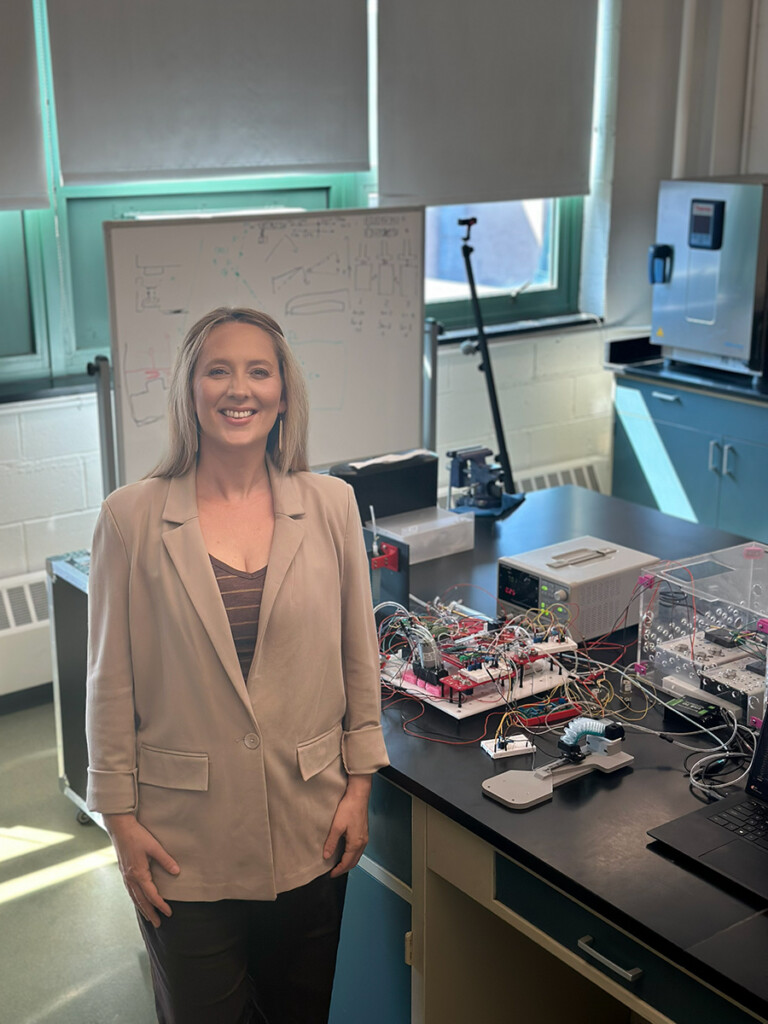
Jacqueline Libby, PhD
Assistant Professor
Department of Mechanical Engineering
Stevens Institute of Technology
Profile | Google Scholar | LinkedIn
Dr. Libby is an Assistant Professor of Mechanical Engineering at Stevens Institute of Technology. She earned her PhD in Robotics from Carnegie Mellon University, her M.S. in Mechanical Engineering from Carnegie Mellon University, and her B.Sc. in Computer Science from Brown University. Before joining Stevens, she worked as a postdoctoral associate at New York University Tandon School of Engineering. She is a recipient of the NSF ERI award in 2023 and the NYU CUSP Postdoctoral Fellowship in 2021. She serves as an Associate Editor for the IEEE Transactions on Neural Systems and Rehabilitation Engineering. At Stevens, she directs the Robotic Systems for Health Lab, where she works with her team on the development of soft robotic orthotics and wearables for medical rehabilitation. The team investigates novel soft robotic silicone fabrication techniques, intelligent and automated modeling of physical-human robot interaction, the fabrication of stretchable sensors, learning-based robotic control, and human-centric design. She combines her background in soft robotics, mechanical design, machine learning, robotic perception, biosensing, and software engineering to build fully integrated systems for physical Human-Robot Interaction in the medical domain. Dr. Libby also teaches undergraduate and graduate-level courses in Statics & Engineering Mechanics, Software Engineering Design, and Applied Machine Learning.
A NEW WEBISTE LAUNCHES IN JULY!
The Robotic Systems for Health Lab
We research novel soft robotic form factors for rehabilitation and human health applications. In particular, we focus on soft robotics for physical Human-Robot Interaction, where active devices are in prolonged physical contact with the human body. Our team takes a multi-disciplinary approach in order to build entirely novel and fully-functional soft robots from the ground up. Our research involves design, fabrication, control, and stretchable sensing.
From a design standpoint, we develop highly customized conformal 3D models for soft actuators that are topologically optimized to interact with the human body. We then use physics-informed simulations to study how soft robots behave, and then optimize how they interact with biomechanical human models.
From a fabrication standpoint, we introduce new techniques for silicone mold casting and 3D printing. From a sensing standpoint, we are investigating new techniques for designing and fabricating stretchable sensor grids.
From a control standpoint, we pneumatically actuate our soft robots with custom developed modular pneumatic control stations that are modulated by various feedback streams. We strive to build technology that can change the lives of individuals suffering from physical disabilities.
Jacqueline Libby, PhD
Assistant Professor
Department of Mechanical Engineering
Stevens Institute of Technology
Profile | Google Scholar | LinkedIn
Dr. Libby is an Assistant Professor of Mechanical Engineering at Stevens Institute of Technology. She earned her PhD in Robotics from Carnegie Mellon University, her M.S. in Mechanical Engineering from Carnegie Mellon University, and her B.Sc. in Computer Science from Brown University. Before joining Stevens, she worked as a postdoctoral associate at New York University Tandon School of Engineering. She is a recipient of the NSF ERI award in 2023 and the NYU CUSP Postdoctoral Fellowship in 2021. She serves as an Associate Editor for the IEEE Transactions on Neural Systems and Rehabilitation Engineering. At Stevens, she directs the Robotic Systems for Health Lab, where she works with her team on the development of soft robotic orthotics and wearables for medical rehabilitation. The team investigates novel soft robotic silicone fabrication techniques, intelligent and automated modeling of physical-human robot interaction, the fabrication of stretchable sensors, learning-based robotic control, and human-centric design. She combines her background in soft robotics, mechanical design, machine learning, robotic perception, biosensing, and software engineering to build fully integrated systems for physical Human-Robot Interaction in the medical domain. Dr. Libby also teaches undergraduate and graduate-level courses in Statics & Engineering Mechanics, Software Engineering Design, and Applied Machine Learning.